
Multi-Asset Allocation Funds Explained: How They Work and What Makes AlphaGrep's NFO Different?
Multi-Asset Allocation Funds have quietly become one of the fastest-growing categories in the mutual fund industry. Investors increasingly want portfolios that can adapt to changing market conditions, instead of relying solely on equities or debt.
The latest entrant in this space comes from AlphaGrep Asset Management, a firm better known in institutional circles for quantitative trading than traditional mutual funds.
While the NFO itself is noteworthy for adopting a quant-based framework, it also provides an opportunity to understand how Multi-Asset Allocation Funds work, why they've gained popularity, and what differentiates one fund from another.
What are Multi-Asset Allocation (MAA) Funds?
MAA Funds are a hybrid category of mutual funds investing in multiple asset classes - equity, debt, commodities (gold, silver, etc), REITs/InvITs, etc. SEBI requires investments in at least three asset classes with a minimum allocation to each.
The category has gained popularity in the past 2 years, driven by flat-ish markets and marketing efforts of AMCs. The AUM of this category has gone up 2.5x from ~Rs. 77,000 crores in May 2024 to ~Rs. 1,90,000cr in May 2026.
The appeal is simple – Diversification without Complexity. Instead of investors deciding - when to increase equity, when to move to debt, when to buy gold - the fund manager does it on their behalf. The fund managers do it based on macro-economic conditions, market outlook, etc., and are generally more equipped to make that call than most ordinary retail investors.
Some other factors driving investors towards MAA Funds:
Flattish but volatile equity markets in the past 2 years, with Nifty 50 CAGR of ~2.5%
Outsourcing asset allocation decision to asset managers
Get exposure to gold, silver, REITs, InvITs and debt; along with equity
Potentially improve risk-adjusted returns (by taking exposure to gold and debt to reduce risk)
Participate across market cycles, if the manager makes the right calls
The key additional risk (compared to equity funds) - The fund manager’s macro calls going wrong. For example, if manager is heavy on equities and markets go down, it could result in losses for investors. Conversely, if manager is heavy on debt but market trends upwards, the returns will be lower than equity mutual funds.
Not All MAA Funds are the Same
Based on the approach applied by the AMC, MAA Funds can broadly be classified as:
Stable Allocation
These funds maintain broadly stable allocation towards equity, debt and gold. There may be small changes (<5-10%) based on the market conditions, but the broader allocation stays stable. These can further be classified into:
Conservative: Inherently have a high allocation to debt. Suitable for investors who want stable returns but some upside participation from equities
Aggressive: High equity allocation or concentrated bets on gold/silver. Suitable for investors who want some de-risking relative to a pure-equity portfolio.
Moderate/Balanced: Balanced allocation across equity and debt, with gold used to reduce portfolio risk.
In our experience, a majority of MAA funds fall within this category – offering predictability to investors in terms of allocation, taxability and overall risk profile.
Tactical Allocation
Some funds take a more active approach. Fund managers increase or reduce allocations depending on market valuations, economic conditions, interest rate expectations or other macro factors. These strategies rely significantly on the judgement and experience of the investment team.
Quantitative Allocation
A relatively newer approach is Quantitative or model-driven allocation.
Instead of relying on human judgement, investment decisions are generated using predefined quantitative models that analyse large amounts of market data.
This is where AlphaGrep's new fund distinguishes itself.
How to Choose the Right MAA Fund?
When evaluating MAA Funds, an investor needs to look at a few more things than a normal equity fund. Some of them are listed below:
How Dynamic is the Asset Allocation?
Investors should see historical asset allocation of the fund they are evaluating – has the allocation shifted during different market cycles? If it has not, then you are probably holding just another equity or hybrid fund that is not dynamic.
As per data compiled by AlphaGrep, the industry average asset allocation stayed broadly stable between 2022 and 2026 – with equity allocation ranging from 56% to 65%, debt allocation from 22% to 26% and gold from 12 to 17%.
A static allocation might be suitable for some investors who prefer predictability, while investors who want actual ‘dynamic’ allocation would prefer a more tactical approach (or at least an allocation that changes when market cycles change). The only way to figure that out is by looking at historical allocations across cycles.
How Does it Fit your Risk Profile?
Identify the risk category of the fund and whether it aligns with what you are trying to achieve. An aggressive MAA for an already equity-heavy portfolio may be of limited use.
Further, try to understand the broader allocation strategy of the Fund – from fund documents, publicly available manager interviews, etc. For MAA Funds, understanding the allocation process may matter more than comparing past returns.
The AlphaGrep MAA: What you Need to Know?
AlphaGrep recently received approval to launch mutual funds, and their first offering is a MAA Fund - among the first quant-based MAA funds in this category.
About AlphaGrep
AlphaGrep is not a traditional asset management company entering quantitative investing. In many ways, it is the reverse.
The firm has spent over 16 years operating as a proprietary investing firm. Around 4 years ago, it expanded into asset management through Alternative Investment Funds, Portfolio Management Services and outbound investment strategies based out of GIFT City.
Its mutual fund offering now brings this quantitative investing experience into the Multi-Asset Allocation category.
The Investment Team at AlphaGrep
Investment strategy is led by Praveen Kumar, who has 16+ years of experience across quantitative trading, portfolio management and investment strategies across multiple asset classes. He looks after the product and investment strategy, while overseeing risk and capital allocation at AlphaGrep.
He was part of the proprietary trading team at Edelweiss where he helped setup and scale the quantitative trading desk and also co-managed its long-short category III AIF.
He is supported by a team of fund managers and researchers with backgrounds spanning BlackRock, Morningstar, Goldman Sachs, and CRISIL.
The broader business is helmed by CEO Bhautik Ambani, who previously helped grow Avendus Capital's Alternate Strategies business into one of the largest onshore hedge funds in India.
AlphaGrep's Quant-based MAA Framework
The distinguishing feature of the fund is its quant-based investment framework, which may be among the first in MAA category.
As per the AMC, the fund will follow a two-engine investment framework:
Asset Allocation Engine: This proprietary model determines how much should be allocated to each asset class. Some of characteristics of this model are risk parity across classes, sharpe ratio optimization (for better risk-adjusted returns), macro-economic overlay (inflation, growth, liquidity cycles, etc.).
This allocation is reviewed and rebalanced every week based on the model's assessment of market conditions.
Security Selection Engine: A separate model is responsible for deciding which securities should be held within each asset class. For equities, this model considers various traditional factors (like earnings yield, P/B, Cash flows, ROE, Earnings stability, leverage, momentum, etc.) as well as additional proprietary factors based on earnings revisions, sentiment, microstructures, ownership, events, seasonality, etc.
This allocation is reviewed and rebalanced daily.
While the models are proprietary, AMC claims that they have been used for their own investing strategies and are based on globally popular sub-models.
Result Back-Testing
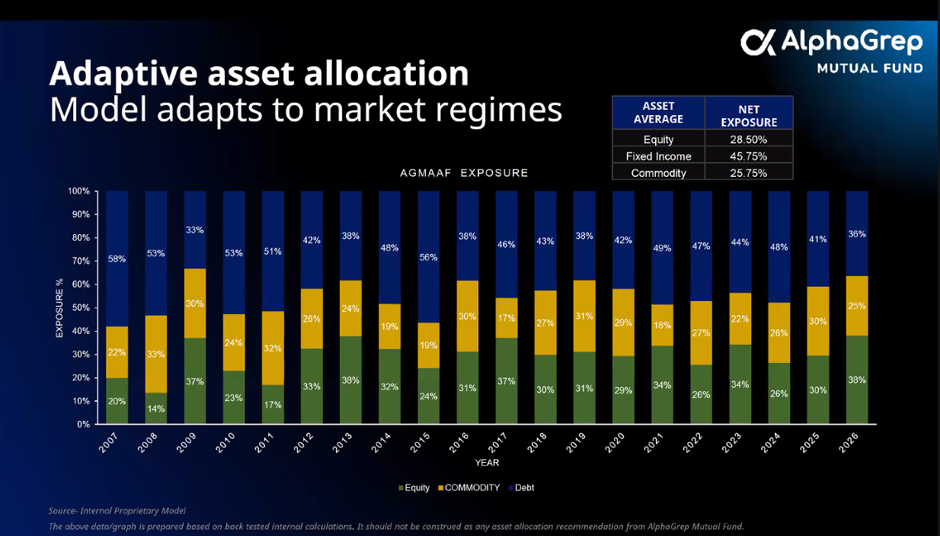
AlphaGrep have published results of back-testing their framework from 2007 to April 2026.
The model showed ‘active’ asset allocation changes between asset classes, with equity average exposure at ~28.5%.
In terms of returns, the back-test shows a CAGR of 14.17% (compared to Nifty return of 11.29%), at much lower volatility and better Sharpe Ratios.
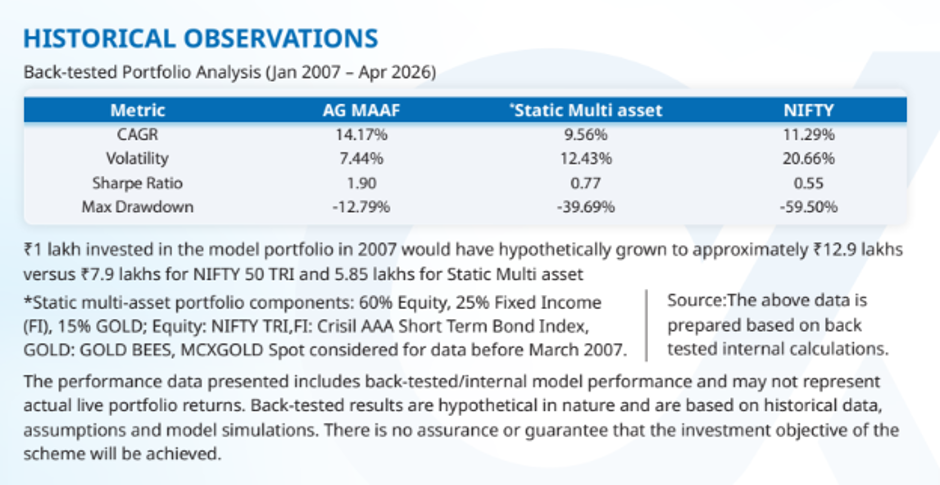
Note – It is unclear if the returns presented here are pre-expenses or post expenses.
The Key Risks
With that re-balancing frequency (and with quant-based schemes in general), the transaction costs are expected to be very high. As per the AMC, they have negotiated a 1bps brokerage (for cash equity) with reputed brokers (against regulatory limit of 6bps for mutual funds), which will help them reduce the TER. Higher portfolio churn is a key risk as frequent rebalancing can eat into your returns.
Further, there have not been (m)any quant-based MAA Funds in the Indian markets – so there is no way to know how these perform in real world. Yes, the AMC has shared back-tested results with favourable risk-return characteristics compared to selected peers – but investors should remember that back-testing reflects how a model would have behaved historically and should not be interpreted as a guarantee of future performance.
Asset Class and Taxation
Most investors associate MAA Funds with a combination of equity, debt and gold.
AlphaGrep MAA Fund intends to include copper and crude as well in their commodity universe.
The equity allocation is expected to be between 35% and 65%. This means the taxability of gains is as follows:
Capital Gains will classify as long term, if held for more than 24 months
Long-Term Capital Gains taxed at 12.5%
Short-Term Capital Gains taxed at investors slab rates
The Bottom Line
MAA Funds are gradually evolving beyond simple combinations of equity, debt and gold. Advances in data analytics, quantitative investing and systematic portfolio management are enabling more sophisticated approaches to asset allocation.
The AlphaGrep MAA Fund represents one such evolution by introducing a fully model-driven framework that separates asset allocation from security selection and broadens the opportunity set beyond traditional assets. However, the true test of any investment strategy lies in its performance across multiple market cycles.
For investors, however, the larger takeaway is that not all MAA Funds are built alike. Funds within the same category can differ meaningfully in their investment philosophy, portfolio construction, rebalancing process and use of quantitative models. Understanding these differences is just as important as evaluating historical returns when deciding whether a fund deserves a place in one's portfolio.
Disclaimer
The information provided in this discussion is strictly for educational and informational purposes and does not constitute professional financial, investment, legal, or tax advice. Mutual fund investments are subject to market risks, including the potential loss of principal, and past performance is not a reliable indicator of future results. All specific fund names, historical events, or financial metrics mentioned are for illustrative purposes only and should not be construed as recommendations to buy or sell any security. You are strongly advised to consult with your advisor or a qualified financial planner to assess your specific risk profile, tax bracket, and financial goals before making any investment decisions.


Comments