
Knack Packaging – An innovator DNA?
Here is a company creating innovative solutions in the bulk packaging business, supported by long-term customer relationships. Dive in to learn more about Knack Packaging's business and the ongoing IPO:
Business and Company Evolution
Knack Packaging (‘Company’) is a packaging solutions company, offering printed and laminated woven polypropylene (PP) bags and pinch bottom bags across multiple sectors for bulk packaging. Before we dive into the products, process, capacity, etc.; let us understand the business evolution of the Company:
Started the business in 1994 making PP bags for cement and fertilizer sector and this continued until 2004.
Promoter Alpesh Patel’s brother Rashmin joined the business in 2004 and they felt the need to differentiate their product offering. This was done by making premium bulk packaging in the form of woven PP bags with customised external printing based on customer design and retaining the core inside material. At that time, industry was offering basic flexo-printing on their PP bags.
2006-07 – Premium rice brands like India Gate, Dawaat, Kohinoor, etc. and sugar companies like Madhur became the core customers
2007-10 – Developed innovative customer-centric offerings in the form of premium matte finish bag, clear window in the bag, metallized layer inside the bag, back seam bag to hide the seam inside the bag, etc.
2011 onwards - Commenced exports business and now ship to developed countries like US, UK, Germany, France, Brazil, Chile, etc. and Cargill is a key global customer
Transition from woven PP (WPP) bags to Printed Laminated WPP (PLWPP) bags to PLWPP + pinch bottom bag to address tampering issues faced by customers. In 2017, Company added machinery to enable pinch bottom bag manufacturing. A standard PP bag costs around ₹8 to ₹10, a PLWPP bag costs around ₹12 to ₹15, while a premium pinch-bottom bag ranges from ₹25 to ₹28.
The sealing solution - Despite having pinch bottom bag manufacturing capacity, customers didn’t adopt it, due to lack of domestic machinery to seal the bag. Company engineered a European-make equivalent sealing machine in India to get a cost-effective solution and partnered with a domestic manufacturer to supply it to Knack’s customers. This sealing technology is patented and rights are with the promoters and NOT the Company.
Which products do they manufacture?


What is the manufacturing process for PLWPP bags?


Manufacturing facilities and capacity
Company has manufacturing facilities in Gujarat, spanning a net land area of 1.2mn sq. ft. with 0.92mn sq. ft. of constructed space respectively and an effective installed capacity of 43.3ktpa.
This is supported by workforce of 1,959 employees including both on-roll and contractual staff, as of May 2026 end.
Company also has in-house printing facility, offering end-to-end design services to clients, including artwork selection or creation and cylinder development. By May 2026, it has developed 73,000+ cylinders for 1,950+ customers and 13,379 SKUs, to support long-term customer retention with 92k sq. ft warehouse dedicated to cylinder storage.


Company added 1st pinch bottom machine in 2017, 2nd machine in 2021, 3rd one in 2023 and recently installing 2 more such machines in its facilities.
Company’s customers use 5-50kg packaging solutions to provide powder or granule form products to end customers. It serves industries like grains and pulses – rice, dal, lentils, etc., flour & spices, sugar, salts, fruits & nuts, animal & pet foods, agriculture, seeds, charcoal, detergents powders & granules, fertilizers, chemicals, cement, tile adhesives, building materials, mineral bags etc.
Key customers include such as Baba Agro Food Ltd, Drools Pet Food Pvt Ltd, Ebro India Pvt Ltd, Laxmi Protein Products Pvt Ltd, Mosaic India Pvt Ltd, KRBL Ltd, Shriram Woven Sacks and DCM Shriram Ltd in India, and international brands across 71 countries like Cristo S.A., Sacos y Empaques Internacionales S.A. de C.V., Cargill and Repi Soap and Detergent PLC.
Understanding the Industry Landscape

Global packaging market is expected to grow at a 4.4% CAGR over CY25-29. Flexible packaging constitutes ~24% of global packaging by value of material.

Flexible packaging is further segmented into consumer and bulk/industrial as under:

The PLWPP bags (5-50kg) market forms 7.1% of the global woven polypropylene (WPP) bags and sacks, and was valued at USD 1.52 billion in CY25. This market is expected to reach USD 1.85 billion by CY29, expanding at a 5% CAGR with PLWPP bags’ share in the global WPP bags and sacks market is expected to increase to 7.4%.
Globally, the PLWPP pinch bottom bags market remains a niche segment, currently accounting for sub-0.2% of the overall WPP bags market, however, these bags are gaining traction as a durable, visually appealing, and cost-effective packaging solution in global markets. The global PLWPP Pinch Bottom Bags market is projected to grow at a CAGR of 5–7%, with Asia-Pacific and North America is emerging as key high growth regions driven by rapid industrialization, expanding agriculture, and increasing demand for branded packaging.
Growth in key end use industries globally:
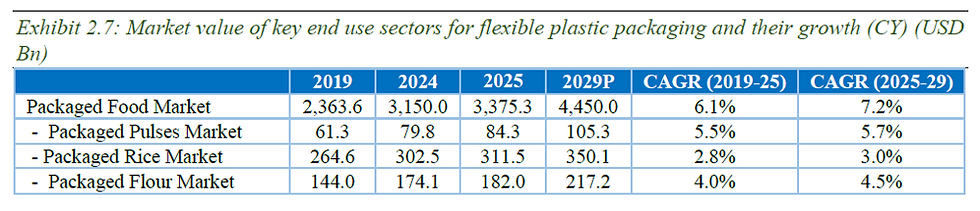

Indian WPP Bags are categorized into PLWPP bags, Uncoated WPP bags, Coated WPP bags, and others. Coated WPP bags dominate the Indian market with 61% share, followed by uncoated WPP bags at 20%, while PLWPP bags account for only 6.5%–7%, as they are a relatively new to the market as compared to others and in the growth phase. However, the share of PLWPP Bags is expected to increase over the next 4 - 5 years and is estimated to capture around 8.5%-9% of the total Indian WPP Bags by FY2029 (implying 15% CAGR over CY24-29 vs. 9.2% CAGR for WPP bags category as a whole). Growing emphasis on branding, shelf appeal, and sustainability is driving shift towards adoption of PLWPP bags, from WPP bags.
The market for PLWPP pinch bottom bags in India is currently quite niche and emerging. Despite the broader WPP bag market being well-established across sectors, the PLWPP pinch bottom bags represent sub-0.5% of the total WPP bags market in India. however, the segment is expected to witness CAGR growth of over 8%-10% in the next five years, as the product gains increasing recognition for its innovative design and advanced functional features, leading to wider acceptance across various end-use industries.
Knack Packaging has a market share of ~10% in India for flexible bulk PLWPP bags, including PLWPP pinch bottom bags for FY25.
Customer-centric Solutions

USA remains a key geography for the Company and also hints towards concentration risk in export business -
Revenue Split by Geography | FY24 | FY25 | FY26 |
India | 43.9% | 43.9% | 43.7% |
Exports | 56.2% | 56.1% | 56.3% |
- USA of Total Revenue | 29.0% | 26.6% | 23.7% |
Cargill accounted for 22% of total revenue in FY24 and this share has reduced to 17% in FY26, however it still indicates a customer concentration risk.
Commodity Pricing and RM sourcing
Company uses key raw materials like Polypropylene granules, LDPE granules, BOPP films and Vinyl/PU base ink, which form 65-70% of the total material cost. Generally, the Company is able to pass on input cost increase to customers. Company follows hedging mechanism for its net open foreign exchange exposure.
Despite current geopolitical crisis, Knack’s primary domestic petrochemical suppliers (Reliance, Haldia Petrochemicals, IOCL, and HMEL) effectively balanced industrial allocations alongside national requirements of domestic LPG distribution. While global raw material pricing fluctuated in line with international indices, Company did not experience any critical material shortages or operational downtime.
Key Milestones

Corporate Structure
Wholly owned subsidiary established in South Africa in 2021 and is engaged in importing and selling HDPE/PP tapes, woven fabrics, woven bags, and BOPP laminated PP woven bags.
JV agreement in April 2025 between the Company, Sacos Y Empaques Internacionales, S.A. de C.V. and Mauricio Ferretis Diaz Infante in Mexico for production, processing, assembling, marketing, distribution, export, and import of packaging materials, including sack bags, woven fabrics, BOPP laminated PP woven bags, inks, adhesives, and other synthetic and natural material packaging. Business operations begun in Apr’26 and the JV intends to support Knack in servicing USA clients more efficiently.
Company operates primarily through two international channels:
Distributor Partnerships: In regions like the USA and Europe, it works with established local distributors with long-standing relationships. They operate as extensions of Knack and handle design coordination and local logistics for regional brands, while Knack manufactures and supplies the bulk bags. They manage regional warehousing and last-mile delivery to end-users.
Direct Strategic Accounts: Company contracts directly as strategic global partners for multinational corporations like Cargill, supplying their operations across multiple countries and locations from a centralized framework.
EPR and Tariff Impact
Company has 38% recycled plastic content in their PP woven laminated bags, while their PP woven bags contain 72% recycled plastic content for manufacturing the finished products. It seems recycled content in its core product PLWPP seems low.

On the USA tariff front , its international customers absorbed the impact or passed it along the value chain, without imposing a financial burden back on the Company. Despite the USA tariff remaining active for an 8-month window, Knack experienced zero customer attrition and zero revenue degradation. Its product enjoys a distinct economic advantage: a bulk bag costs roughly 25 to 30 cents, but it protects and contains premium cargo worth USD 30. Because the packaging represents barely 1% of the total product value, price fluctuations do not severely impact the buyer's unit economics. This insulation protected it from tariff-related disruptions.
Competitive Landscape
Key Global Peers include Mondi Group (Austria), Amcor plc (Switzerland), Polytex Fiber (USA), ProAmpac (USA), Hood Packaging (USA & Canada), etc.; while Indian peers include Kaypee Polymer Pvt Ltd, Sah Polymers Ltd, Kaypee Polyfab Pvt Ltd, Lakhdatar International Pvt Ltd, Shri Maa Polyfabs Ltd, etc.

Growth Outlook
The key growth triggers include structural migration of industries to better packaging, the organic sales growth of existing clients driven by enhanced branding, and the overall macroeconomic growth of their respective industries.
The IPO proceeds from fresh issue are planned to be utilised towards setting up a new project site near Mehsana to add ~49.1ktpa of installed capacity. Company also plans to decommission 15.6ktpa capacity from Unit 3, thereby resulting in 32.7ktpa of net installed capacity expansion.
Management expects new capacity to go live by 2028 and usually the standard project setup timeline is 12-15 months.
Financials
Company’s original commodity product from the 1994–2004 era viz. the basic WPP bag now contributes just 3.5% to 4% of revenue and its margins are naturally low because it is a pure commodity product. The PLWPP bags that drove growth from 2004 to 2017 and generate around 70% to 72% of current annual revenue, while the newest category viz. the PLWPP + pinch-bottom bags account for 20% to 21% of total revenue.

Valuation
Knack Packaging is priced at 22.4x FY26 P/E on a post money basis. Assuming 15% yoy earnings growth in FY27, Company is priced at 19.5x P/E on 1-year forward basis. This is relatively cheaper compared to listed packaging players like TCPL Packaging, Time Technoplast and Mold-tek Packaging which are trading at 18-30x FY26 P/E.
Issue Details, Capital Structure and Anchor Book
The IPO is a combination of fresh issue of Rs380cr and an offer for sale of Rs60cr, diluted by the promoter group. Promoter holding post issue will be at 70.6% and market capitalisation of Knack Packaging will be at Rs2080cr based on upper price band of the IPO.
The fresh issue proceeds are mainly for partial funding (320cr) of capex towards setting up of new manufacturing facility (total outlay of Rs365cr) at Borisana situated at Kadi, Mehsana, Gujarat. Net capacity addition of 32ktpa planned by 2028, besides current capacity of 43ktpa resulting in a total installed capacity of 75ktpa.
Company is a family-owned corporate entity with no past track record of external investors.
Good anchor book in the form of Axis AIF (30% anchor allocation), Ashoka (WhiteOak), Bandhan MF, BoI MF, Gagandeep Credit Capital (Enam group), etc.
Key Risks
20%+ revenue from USA and 50%+ export revenue, hence subject to geopolitical disruptions and currency price volatility
Raw material prices are commodity-linked so subject to commodity price volatility
Delay in commissioning of new project site
Disclaimer
We are NOT registered as research analysts with SEBI. This blog is purely for informational purposes and is not a recommendation to buy/sell/subscribe to any security. Do your own due diligence, consult your financial advisor and thoroughly evaluate the risks before undertaking financial decisions.
Comments